
Writing Problem Statements
April 2026 By Patience Mumbi
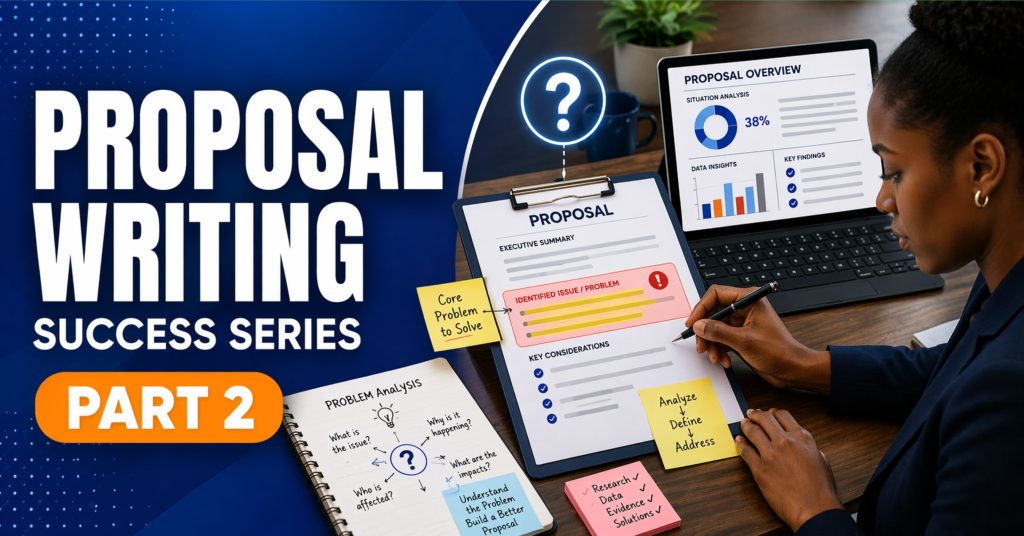
In Part 1 of the Proposal Writing Success Series, we explored how to structure a proposal, outlining the key sections that make a proposal clear, organized, and compelling. However, structure alone is not enough. At the heart of every successful grant proposal is a powerful problem statement. This is the section that convinces donors that a real issue exists, that it matters, and that your project is worth funding. In this article, we will explore how to write a strong problem statement for grant proposals—one that captures attention, builds urgency, and lays the foundation for a winning proposal.
What Is a Problem Statement in a Grant Proposal?
A problem statement in a grant proposal is a clear, focused, and evidence-based explanation of the issue your project seeks to address. It is one of the most critical sections because it justifies the need for funding and convinces donors that the problem is real, significant, and worth solving.
It answers key questions such as:
What is the problem? Clearly define the issue your project is addressing. It should be specific, well-articulated, and easy to understand.
Who is affected? Identify the target population, community, or group experiencing the problem, showing who will benefit from the intervention.
How serious is it? Explain the scale and severity of the problem using data, statistics, or credible evidence to demonstrate its impact.
Why does it need urgent attention? Highlight the consequences of inaction and explain why the issue cannot be ignored or delayed.
What gap exists that your project will address? Show what is currently missing in terms of solutions, services, or knowledge, and how your project fits into that gap.
In simple terms, it answers:
“Why should a donor care?”
A strong problem statement makes it clear that your project is not just important—but necessary, timely, and capable of making a meaningful impact.
Why the Problem Statement Is Critical
1. It Determines Whether You Get Funded
Donors often decide whether to continue reading a proposal based on how well the problem is defined. A weak problem statement can lead to immediate rejection—even if the idea is good.
2. It Builds Urgency and Relevance
A strong problem statement shows that the issue is:
- Real
- Significant
- Worth solving now
3. It Justifies Your Entire Proposal
Everything else in your proposal, goals, activities, budget, must connect back to the problem. If the problem is unclear, the entire proposal becomes weak.
Key Elements of a Strong Proposal Problem Statement
1. Clear Description of the Problem
Start by clearly stating the issue your project seeks to address. This should be direct, specific, and easy to understand. Avoid general statements. Be precise about:
What is happening: Clearly describe the situation or condition that represents the problem.
Where it is happening: Specify the location, community, or setting where the issue exists.
Who is affected: Identify the individuals or groups experiencing the problem.
Clarity at this stage helps donors quickly understand the issue and its context.
2. Evidence and Data
Support your claims with credible and relevant evidence. This shows that the problem is real, measurable, and significant. This may include:
Statistics: Numerical data that shows the scale or severity of the issue.
Reports: Findings from organizations, government bodies, or institutions.
Surveys: Data collected from the target population.
Field observations: Practical insights based on real-life experiences or assessments.
Data makes your problem believable and convincing, increasing donor confidence.
3. Target Population
Clearly define who is affected by the problem. This helps donors understand the beneficiaries of your project. This may include:
Age groups: For example, youth, children, or the elderly.
Gender: If the problem affects a specific gender group more significantly.
Location: Specific communities, regions, or countries.
Socioeconomic status: Income level, employment status, or vulnerability.
The more specific you are, the stronger and more relatable your case becomes.
4. Root Causes
Go beyond describing the problem, explain why it exists. Identifying root causes shows deeper understanding and strengthens your credibility. This may involve factors such as limited resources, policy gaps, lack of awareness, or systemic challenges.
Understanding the cause helps justify why your proposed solution is appropriate.
5. Impact and Consequences
Explain what happens if the problem is not addressed. This highlights the urgency and importance of your project. This could include:
Economic challenges: Loss of income, unemployment, or reduced productivity.
Social issues: Inequality, exclusion, or community instability.
Health risks: Increased illness, poor well-being, or limited access to care.
Environmental damage: Degradation, pollution, or unsustainable practices.
Highlighting consequences helps donors see the cost of inaction.
6. The Gap
Identify what is missing in current efforts, research, or solutions. This is what your project is designed to address.
Explain:
Why current solutions are not enough: Show limitations in existing programs or interventions.
What has not been addressed: Identify overlooked areas or unmet needs.
Your project should clearly fill this gap, demonstrating its relevance and value.
How to Write a Problem Statement (Step-by-Step)
Step 1: Start with Context
Introduce the broader issue to set the stage for your problem. This helps the reader understand the general area of concern before narrowing down.
Example:
Access to quality education remains a challenge in many rural communities.
Explanation:
At this stage, you are highlighting a widely recognized issue without going into specific details yet.
Step 2: Define the Specific Problem
Narrow down to a clear and specific issue within the broader context.
Example:
In rural districts of Zambia, many schools lack adequate learning materials and trained teachers.
Explanation:
This makes the problem more focused, relevant, and easier to address through a targeted intervention.
Step 3: Provide Evidence
Support your statement with credible data to show that the problem is real and significant.
Example:
Recent reports indicate that student-to-teacher ratios exceed recommended standards in several districts.
Explanation:
Evidence strengthens your argument and increases donor confidence in your proposal.
Step 4: Identify the Affected Group
Clearly state who is impacted by the problem.
Example:
Primary school learners in underserved communities are the most affected.
Explanation:
This helps donors understand who will benefit from your project.
Step 5: Explain the Impact
Show the consequences of the problem if it is not addressed.
Example:
This leads to poor academic performance and limited future opportunities.
Explanation:
Highlighting impact creates urgency and emphasizes the importance of intervention.
Step 6: Highlight the Gap
Explain what is missing in current efforts or solutions.
Example:
Despite government efforts, there is limited support focused on improving learning resources at the community level.
Explanation:
This justifies your project by showing where existing solutions fall short.
Step 7: Link to Your Intervention
End by connecting the problem to your proposed project or solution.
Example:
This project aims to address these gaps by providing learning materials and teacher support programs.
Explanation:
This creates a logical transition from the problem to your proposed intervention, making your proposal cohesive and persuasive.
Example of a Strong Problem Statement
Access to quality education remains a significant challenge in many rural communities in Zambia. In several districts, schools face a shortage of trained teachers and adequate learning materials, resulting in overcrowded classrooms and limited student engagement. According to recent reports, student-to-teacher ratios in these areas exceed recommended levels, affecting the quality of education delivered. As a result, many learners struggle to achieve basic literacy and numeracy skills, limiting their future opportunities. While government initiatives have made progress, there remains a gap in community-level interventions that directly support schools with essential resources. This project seeks to address this gap by improving access to learning materials and strengthening teacher support systems in targeted communities.
Common Mistakes to Avoid
- Being too vague or general
- Writing without evidence
- Focusing on solutions instead of the problem
- Ignoring the target population
- Failing to show urgency
- Overloading with unnecessary information
Conclusion
A strong problem statement is the foundation of a successful grant proposal. It presents a clear, compelling narrative, supported by credible evidence, that convinces donors your project is both necessary and capable of creating meaningful impact. By clearly defining the problem, identifying those affected, and highlighting the urgency and existing gaps, you position your proposal as relevant, timely, and solution-driven.
When done well, a problem statement does more than describe a problem—it makes it impossible to ignore, motivating donors to take action and support your project.